Thursday, July 29, 2021

 My fourth trail planted on the Cote D'Azure!


Hi Linda, 

You just passed the 80% milestone on the Côte d’Azur Virtual Challenge! 

This is great news because it means we will plant a real tree thanks to you! 
Each time you reach one of the milestones shown on the map, we will plant a tree to help restore healthy forests in locations around the world. 
We have partnered with Eden Reforestation Projects to plant the trees. 
You can check out our current partnership status with them here

Keep up the great work and thanks for helping our virtual global community make a difference in the real world. 

 Some pics of the highlights of my third Cote D'Azur postcard:


Nice Carnival Parade


Nice Carnival Parade Nightime


Nice Contemporary Art Museum


Nice Castle Hill Park


Nice Castle Hill Park Monument

 Another post card arrived on my Cote D'Azur journey!
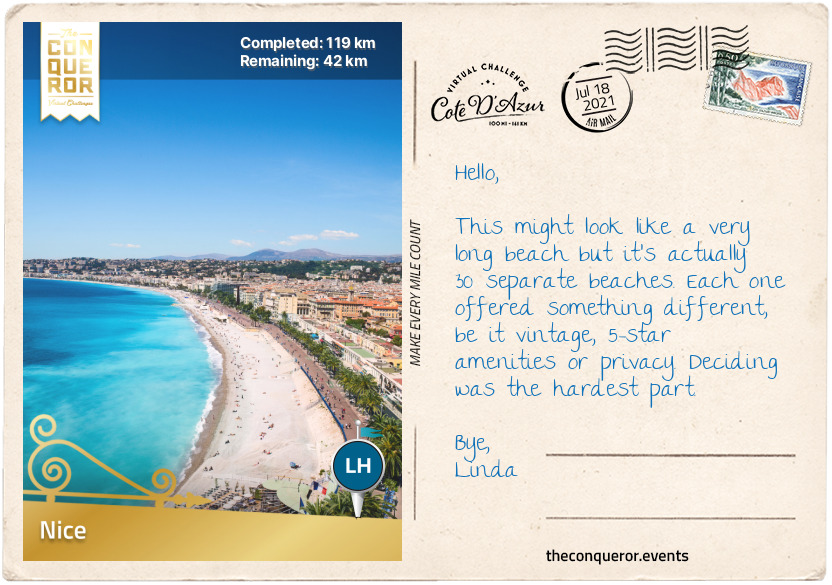

Nice is the seventh most populous city in France, second-largest city on the Mediterranean coast and second-largest city in the region. With an airport a mere 4mi (7km) from the city centre, Nice is the gateway to the French Riviera.

It has a plethora of museums, festivals, a hilltop park with uninterrupted views of the sea, several squares surrounded by buildings in red ochre, a 4mi (7km) beach alongside the main promenade and the old port. So many options, where to begin?


Starting with the festivals, Nice is host to an annual jazz festival and the Carnaval. The first Jazz Festival opened in 1948 with the likes of Louis Armstrong, Velma Middleton and Earl Hines in attendance. The Nice Carnaval is one of the major international carnival events alongside the ones in Rio de Janeiro, Brazil and Venice, Italy. The very first Carnaval took place in 1873 - although records indicate one as early as 1294 – with a parade of masquerades, floats and competitions. The event has a special theme chosen each year where artists create floats and figures made out of papier-mâché. They parade down the street interspersed with street performers and musicians. One of the highlights that is unique to Nice's carnival is the costumed actresses atop floral floats showering the audiences with flowers. This Flower Battle as it's called was started in 1876 as a way to exchange flowers and entertain tourists but today it represents and honours the work of local producers.

Nice has long drawn artists to its shores with the likes of Henri Matisse, Marc Chagall and sculptor Sacha Sosno. Both Matisse and Chagall have museums dedicated to their works. Matisse was known as the "King of Colour". Bedridden due to illness he was forever on a quest to induce more and more colour into his paintings making them as bright as possible. Loving birds and flowers, they are found throughout his works. When he could no longer paint, he took to cut-out collages arranging them into varying compositions creating murals and large scale works. His greatest achievement was the stained glass windows on the Rosaire Chapel which he gifted to his friend Monique, who was his nurse for a period of time later becoming a nun.

In the heart of Nice located amongst century-old buildings is the highly modern Contemporary Art Museum and within its perfectly manicured garden sits Sosno's unique square head sculpture. The cube-shaped sculpture with a chin is titled "Thinking Inside the Box" and at 85ft (26m) tall it houses a library over three floors. Sosno believed his art needed to leave a lot to the viewer's imagination by creating works that were either having a void, imagine a torso sculpture with a rectangular section missing from the centre of it, or the opposite filled with "obstructive addition" such as the square head. In his words: "I only do 50% of the work; other people have to finish creating the sculpture".

To the east of the city up on a hill is the historic Castle Hill park. Once home to a citadel that was demolished in the 18th century, it now boasts panoramic views of Angels Bay, the old port and the city skyline. Taking a stroll through the forested canopy I reached the 18th century historic cemetery adjacent to the Jewish cemetery and Holocaust memorial built atop the fortress' remains. Notable figures such as Alfred Van Cleef jewellery and luxury watches designer; Emil Jellinek creator of Mercedes trademark; and Gaston Leroux the author of the famous Phantom of the Opera are buried here. Just below the top viewing platform is a manmade waterfall and pond. Reaching the top I am afforded the quintessential view of the beach, the azure sea, the promenade and the dense city alongside it.

Descending from the park and rounding it at the base, I came across a massive monument built into the rocky hillside commemorating the 4,000 locals killed in WWI. Built in the mid-1920s the memorial is 105ft (32m) tall. The large urn in the centre holds the names of the 3,665 Niçois soldiers who died in the war. 

Now to stroll into the old port, find an outdoor seat at a café with a view of the ocean and time to settle in with the tuna based Salade Niçoise because it was invented here paired with a glass of Provencal Rosé with its pretty salmon colour and crisp and refreshing taste. Bon appétit.

 My second tree planted on the Cabot Trail!

Hi Linda, 
You just passed the 40% milestone on the Cabot Trail Virtual Challenge! 

This is great news because it means we will plant a real tree thanks to you! 
Each time you reach one of the milestones shown on the map, we will plant a tree to help restore healthy forests in locations around the world. 
We have partnered with Eden Reforestation Projects to plant the trees. 
You can check out our current partnership status with them here

Keep up the great work and thanks for helping our virtual global community make a difference in the real world. 

Thursday, July 15, 2021

 Some pics of the highlights of my third Cabot Trail post card


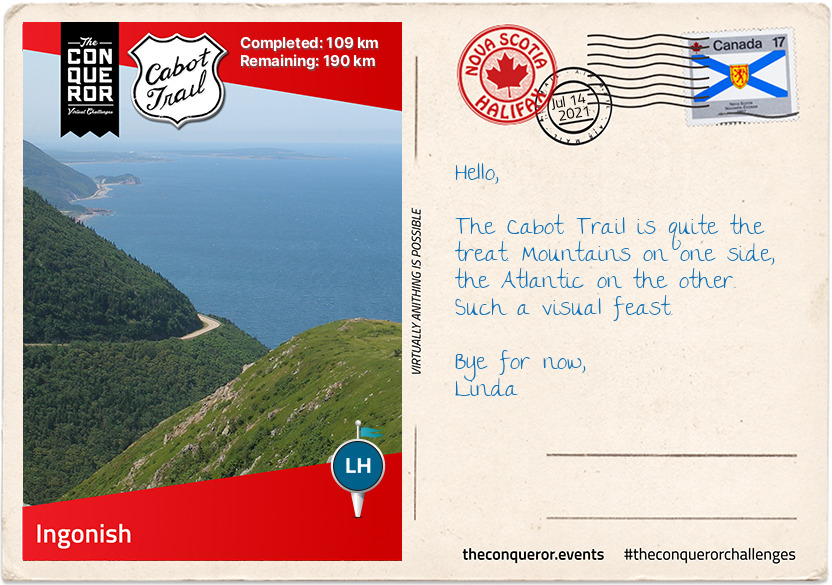
Ingonish. Frank Trail


Ingonish


Highland Links Golf Course


Middle Head Hiking Trail


Ingonish Beach


 Ingonish Beach


 My THIRD post card on the Cabot Trail!

I made it to Ingonish on the north-east coast of Cape Breton. Made up of 5 small communities, their economy centres around tourism and fishing.

Golf seems to prevail and the nearby Highland Links Golf Course regularly ranks in the Top 10 golf courses in Canada. The Scottish influence is evident in holes named Heich O' Fash, meaning Heap of Trouble and Killiecrankie, which is a long narrow pass in the Scottish Highlands and played a significant role in the Battle of Killiecrankie during the 1689 Jacobite Rebellion. Many of the fairways resemble the Scottish topography but the original designer, Stanley Thompson, just called it his "mountain and oceans course" and established himself as the finest golf course architect in Canada.

Next to the golf course is Keltic Lodge which was originally built in 1910 as a summer retreat for the Corson family who owned the land at the time. When the Cape Breton Highlands National Park was developed the Nova Scotia government saw the value of the headland where the lodge was situated and purchased the land from the Corson's. By 1951 the new Keltic Lodge was constructed providing accommodation services to the area.

Just beyond the Keltic Lodge is the Middle Head Peninsula hiking trail. It is a 3.8km trail that follows a narrow peninsula with ocean bays on either side, finishing on headland cliffs overlooking the Atlantic Ocean with views of Cape Smokey Provincial Park to the right and Ingonish Island to the left.

For any ocean enthusiast there is a unique opportunity to swim in both freshwater and saltwater in the same area. At Ingonish Beach the saltwater is off a white sandy beach on one side and the other is the freshwater swimming hole created by waves piling up rocks creating a barrier which then cornered off a cove from the ocean and over time filled with freshwater.

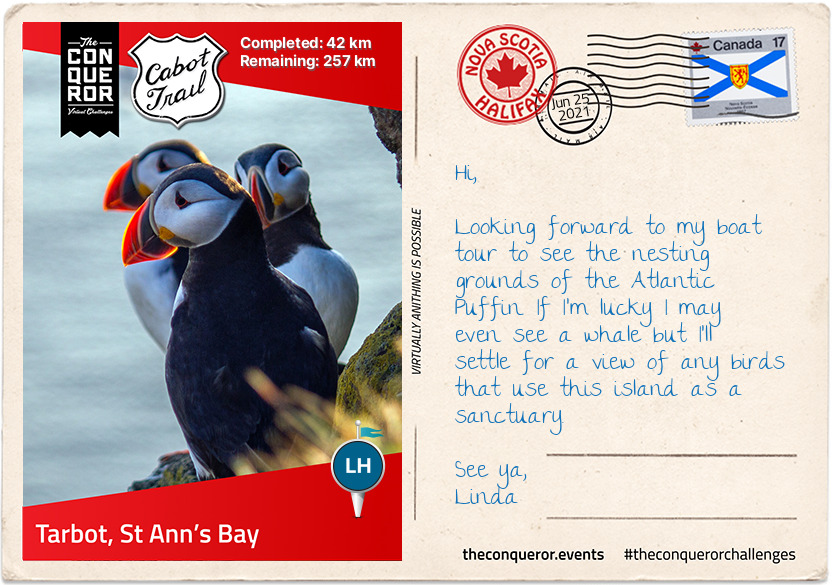
Alternatively, if you don't feel like a swim a boat cruise during the summer months provides for excellent opportunities to see various types of whales, dolphins, seals and puffins.

Regards,

Linda

 My third tree planted on the Cote D'Azur Journey!


Hi Linda, 

You just passed the 60% milestone on the Cote D'Azur Virtual Challenge! 

This is great news because it means we will plant a real tree thanks to you! 
Each time you reach one of the milestones shown on the map, we will plant a tree to help restore healthy forests in locations around the world. 
We have partnered with Eden Reforestation Projects to plant the trees. 
You can check out our current partnership status with them here

Keep up the great work and thanks for helping our virtual global community make a difference in the real world. 


Friday, July 9, 2021

 Some pics of the sights spoken of in my third Cote D'Azur post card. 


Cannes Port


Croisette Beach


Marché Forville


Le Suquet


Notre-Dame d'Éspérance


Sainte-Marquerite Island - home of the Man in the Iron Mask


 A THIRD post card has arrived on the Cote D'Azur route!


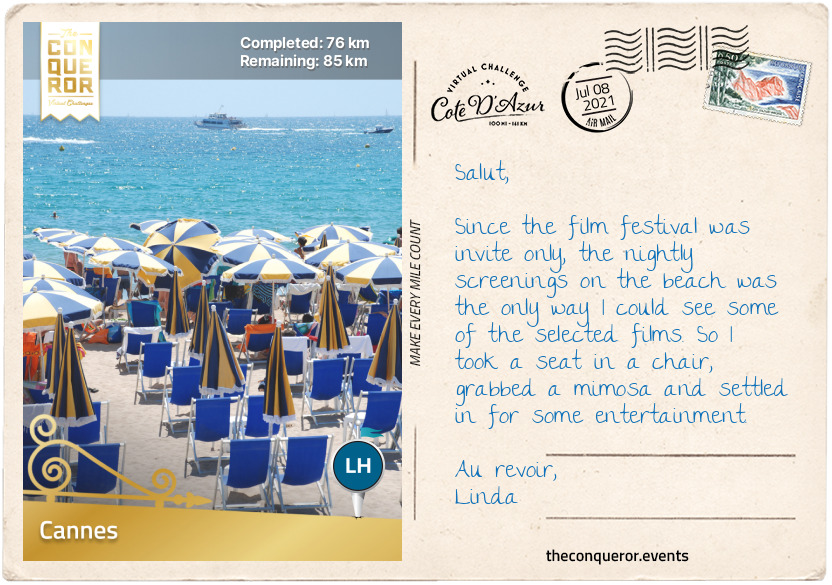
Tucked away between the Cannes Port to one side and turquoise Croisette Beach on the other is the Palais des Festival de Cannes where the annual Cannes Film Festival is held. The internationally renowned Film Festival has been running for over 70 years. As part of the Big Five film festivals which include Venice, Berlin, Toronto and Sundance in the US, the Cannes Film Festival is where all new films and documentaries from around the world are previewed. 

The festival is a prestigious event that is by invitation only. It is attended annually by nearly 40,000 guests including celebrities, rising stars, hopefuls of the Palme D'Or Award and a staggering 4,500 journalists show up to capture every facet of the event. 

As famous as the event is today, the festival had very interesting beginnings. Back in the 1930s the only festival that existed worldwide was the Venice Film Festival which started in 1932. Presenting movies for the coveted Mussolini Cup, the French became disillusioned when the judges' decisions were overruled by Mussolini and Hitler and instead of a French film winning, the winners were an Italian film and German documentary. 

Unhappy with the situation the French, British and Americans withdrew from the festival and inspired the French to establish their own film festival. As such Le Festival International du Film was born with Cannes as the chosen location, largely due to its Côte d'Azur location. The first event was slated for September 1939 with Hollywood celebrities brought in by an ocean liner chartered by the film studio Metro-Goldwyn-Mayer. Unfortunately, World War II started in September and although the festival was delayed 10 days eventually it was cancelled. The festival was relaunched in 1946 and with the exception of two years when it didn't take place, the festival has been a major presence in the film industry remaining the most exclusive event of all film festivals.

Of course Cannes was not just about the film festival. It's major street, Boulevard de la Croisette, is one of the most iconic streets in France. It runs for a mile (1.6km) alongside the coastline with luxurious hotels, casinos and designer stores dotting the street. 

As lovely as that may be what I was more interested in was the Marché Forville, a large undercover food market where I could indulge in locally grown fresh produce, a Spanish paella or Italian ravioli with Provençale pasta sauce. 
From here I took a stroll through Le Suquet, an old neighbourhood that was once the original fishermans' residential area. With pastel-coloured buildings lining the steep cobbled street, the area was filled with restaurants. As I made my way up, I came across Notre-Dame d'Espérance, a 14th century stone church with a belltower, and adjacent to it is a medieval castle that houses a unique collection of medieval artefacts, paintings and Asian instruments. The collection was bequeathed by a local resident and the castle is now used as a museum. A further 109 steps took me to the top of the tower for a spectacular view of Cannes.

In the distance I could see Sainte-Marguerite Island, which is famously known for holding the mysterious Man in the Iron Mask as prisoner for a period of 11 years. He wore a mask because King Louis XIV never wanted him to be identified. Plenty of speculations have been made since his death in 1703 but no conclusive evidence has ever been found. One thing for certain was that his mask was made of cloth not iron and Alexander Dumas was inspired to write his novel, The Man in the Iron Mask. The island is a museum today which includes the masked man's cell. 

 My SECOND tree planted on the Cote D'Azur  route!

Hi Linda, 
You just passed the 40% milestone on the Cote D'Azur Virtual Challenge! 

This is great news because it means we will plant a real tree thanks to you! 
Each time you reach one of the milestones shown on the map, we will plant a tree to help restore healthy forests in locations around the world. 
We have partnered with Eden Reforestation Projects to plant the trees. 
You can check out our current partnership status with them here

Keep up the great work and thanks for helping our virtual global community make a difference in the real world. 


 My first tree planted on the Cabot Trail!

Hi Linda, 
You just passed the 20% milestone on the Cabot Trail Virtual Challenge! 

This is great news because it means we will plant a real tree thanks to you! 
Each time you reach one of the milestones shown on the map, we will plant a tree to help restore healthy forests in locations around the world. 
We have partnered with Eden Reforestation Projects to plant the trees. 
You can check out our current partnership status with them here

Keep up the great work and thanks for helping our virtual global community make a difference in the real world. 


 Some pics of the sights mentioned in the last post card. 


Esterel Massif, made of red volcanic rock, at the foot of which sits the small town of Saint-Raphael.


San Raféu Church - Romanesque


Archangel Raphael with Tobias.


Pastis!


 Another post card on the Cote D'Azur!


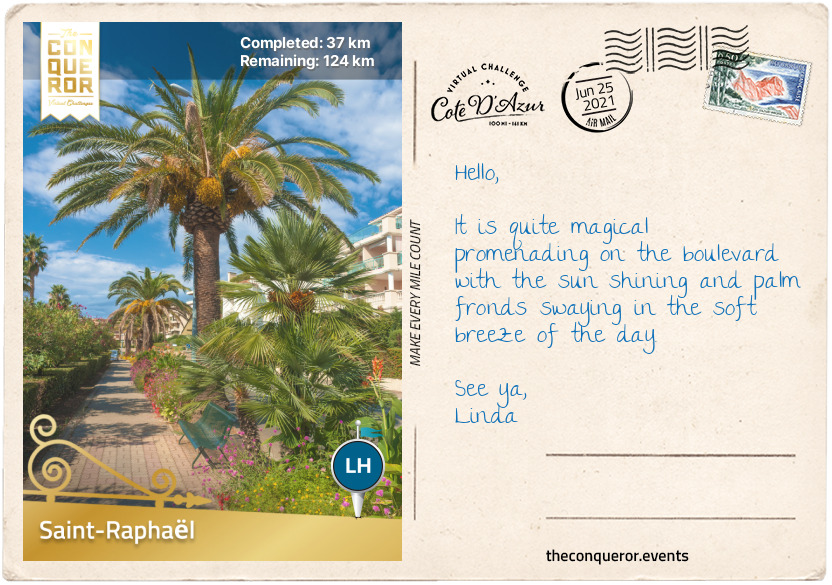
At the base of Esterel Massif is the seaside town of Saint-Raphaël. With 22mi (36km) of coastline and numerous beaches and coves, this is one place to put up an umbrella, lay down a towel and while away the day soaking up the sun or swim in the azure sea.

First of all though, I had to explore the old "Quartier du Village", the old town where each day it hosts a flower and vegetable market. Offering Provencal food which is a region in south-eastern France, my tasting senses delighted in dipping croutons in a tapenade of black olives mixed with capers, anchovies, garlic and olive oil. Quenching my thirst with a refreshing Lime Perrier sparkling water I continued exploring. 

Not far from the market I came across the Romanesque church of San Raféu. Originally built in the 12th century, a tower was added a century later to represent power rather than any defensive purpose. The 129 steps up the tower presented me with a breath-taking panoramic view of the town, the sea and the Massif. The presbytery has been converted into a museum showcasing artifacts from underwater excavations along with items from the Palaeolithic era to the Iron Age (3.3mya – 332BC).

I made my way down to the marina tucked away between the beaches in the Bay of Saint-Raphaёl and promenaded around it to Le Jardin Bonaparte, a public park with views of the old port and the sea. At the tip of the park stands a 15ft (5m) bronze statue of Archangel Raphaёl, whom the town was named after, holding hands with little Tobias. Just like the statue, Raphaёl and Tobias appear in the town's coat of arms. The story told is that "Tobias was told by his father to collect money deposited with a relative, a merchant in a distant town; before he went he was to find a trustworthy companion. That companion was the Angel Raphael and together with Tobias' dog they set out". As such Raphaёl is seen as a symbol of companionship and protection.

With the sun setting and a full day of sightseeing, I located a sunbed with an umbrella near a restaurant and stretched out with an aperitif. Since it's revered in the South of France I chose a Pastis, an aniseed and liquorice flavoured spirit. This transparent dark yellow spirit turns a cloudy pale yellow colour once mixed with water which is the preferred way to drink it. Makes for an interesting looking drink which as they say "must be tried at least once".
Wednesday, July 7, 2021

 St. Anns Bay and the Gaelic College


 Another post card from the Cabot Trail!


I am making my way along St Ann's Bay on the east coast of the trail and it should probably be called "Artisan Coast" because from the tiny rural community of St Ann all the way up to Wreck Cove it is one long list of artisan shops, galleries and studios offering items made of clay, glass, leather, pewter, iron, paint, fibre and canvas.

St Ann is one of the oldest settlements in North America. It acquired its Gaelic roots when the Scottish Reverend Norman McLeod on his way to Ohio was forced ashore during a storm. He setup his ministry and was soon followed by boatloads of Scots from the motherland becoming the first Scots in St Ann. He eventually immigrated to New Zealand with many of his followers and his property in St Ann is today occupied by the Gaelic College of Celtic Arts and Crafts.

Whilst I visited the Gaelic College, I came across another book called Letters to Mac-Talla from John Munro, A Cape Breton Gael in New Zealand 1894-1902, and it is a humorous compilation of 32 letters written home to Nova Scotia. Having lived for 40 years in Nova Scotia, together with 900 fellow Highlanders, John sailed to New Zealand where he spent the next 40 years. In his letters he wrote about St Ann's history, the Mi'kmaq (local indigenous people), first contact with Europeans, the French Occupation, the local flora and fauna along with his experience in New Zealand, the Maori and his fellow Scots.

The nearby Great Hall of Clan Museum took me on a journey of the early settlers from the Highlands of Scotland to their evolution into a Cape Breton way of life and Rev. Norman McLeod's journey from Scotland to St Ann to Waipu, New Zealand.

Bye for now,

Linda

 My first tree planted on the Cote D'Azur journey!


Hi Linda,

You just passed the 20% milestone on the Cote D'Azur Virtual Challenge!

This is great news because it means we will plant a real tree thanks to you!

Each time you reach one of the milestones shown on the map, we will plant a tree to help restore healthy forests in locations around the world.

We have partnered with Eden Reforestation Projects to plant the trees. You can check out our current partnership status with them here.

Keep up the great work and thanks for helping our virtual global community make a difference in the real world.

 St. Tropaz and a Pastry

Here are some photos of St. Tropaz and some photos of the restaurant and pastry mentioned in the post card. 


Tuesday, July 6, 2021

 The first post card on the Cote D'Azur!


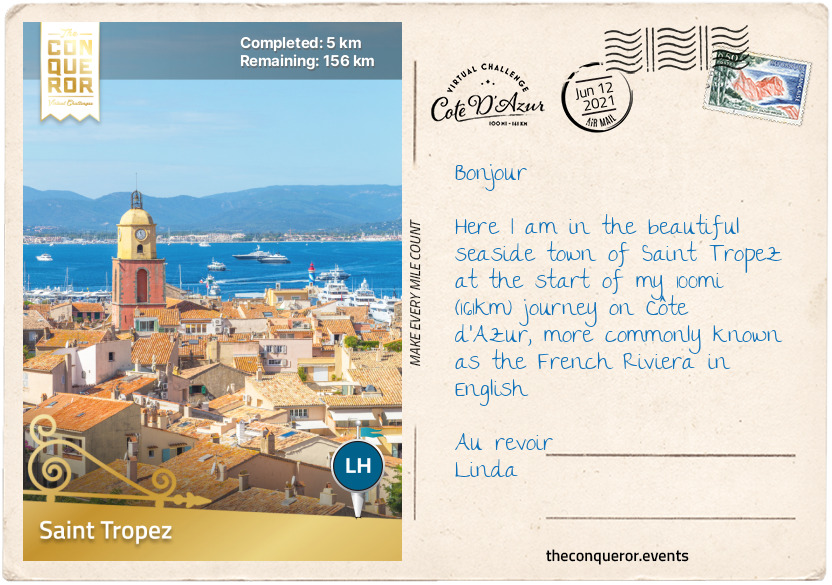
After an hour of travelling from Toulon-Hyères airport, I arrived in the once sleepy fishing village of Saint Tropez. Located on a headland with narrow cobblestone streets, Saint Tropez came to prominence in the second half of the 20th century with an influx of artists and later wealthy socialites. Today it continues to draw wealthy visitors and tourists.

Saint Tropez was named after Saint Torpes of Pisa, the patron saint of sailors. Torpes was once a gladiator or knight, it's not clear which one but he was in the service of Emperor Nero. He turned to Christianity and when he refused to denounce it, the Emperor had him decapitated. His head was tossed in the Arno river and his body along with a rooster and dog were placed in a boat and sent out to sea. According to legend the boat landed in Saint Tropez near the current sailors' cemetery. Found by a holy woman, the town was named in his honour. The rooster and dog fled and both had towns named after them – Cogolin and Grimaud.

The town is often considered as one of three starting points of Côte d'Azur – the literal translation is Azure Coast. In English we refer to it as the French Riviera. The Riviera runs the length of the southeast corner of France through the well-known towns of Cannes and Nice, the city-state Monaco and ending in Menton right at the border of France and Italy.

The term Côte d'Azur was coined in 1887 by poet and writer, Stéphen Liégeard when he wrote of his experience on the French Riviera describing the beautiful area and the deep azure colour of the sea. The book titled La Côte d'Azur was printed in 1888. Said to have been one of his greatest writings, Liégeard was awarded a Bordin Prize issued by the French Academy of Sciences.

At the foothill of Saint Tropez's harbour pier is Tour Portalot, a 15th century tower that was built along with three others to fortify the town and protect its coast and port. Taking the stairs to the top of the tower, I am enchanted by the expansive views of the sea, as far as the eyes can see. The tower overlooks the Gulf of Saint Tropez, busy with ferries and pleasure boats cruising in and out of the harbour.

To the west of the tower up on a hill is the 17th century citadel. Built in a hexagonal shape with three turrets and several cannons, the citadel can only be accessed via a drawbridge. With its prime position on a hill, the citadel together with the towers built in the port, protected the town and the coastline for nearly two centuries. When the citadel couldn't withstand the strength of modern artillery shells its protective and strategic role diminished and fell into disuse. Following extensive renovations the citadel was opened as a maritime museum. Its rooftop terrace provides sweeping aerial views of the town and Mediterranean Sea.

Before I depart Saint Tropez, I took a short stroll to La Tarte Tropezienne Restaurant to check out its famous pastry of the same name. When Alexandre Micka, a young Polish baker, created a dessert using his grandmother's recipe in the 1950s, he could not have imagined how iconic the dessert would become in Southern France. The dessert rose to fame when Brigitte Bardot, in town to film a movie, was introduced to the delectable pastry and is said to have fallen in love with it. Brigitte suggested that the dessert be named after the town and as Brigitte grew in popularity so did the dessert. The pastry name was eventually trademarked and many stores were opened across Southern France.

An uncomplicated dessert the original version was made up of traditional French brioche that was split in half, filled with a vanilla and lemon cream, and topped with hard sugar crystals. Today the dessert is available in different shapes and sizes and occasionally with strawberries. More than 65 years later the cream filling remains a closely guarded secret and continues to be made with traditional methods.

Cote DAzur Race Bib

 Adding another challenge!  As I thought, the Cabot Trail is too long - too long between milestones and rewards. So I have added the Cote D'Azur to my challenges. It is a little shorter and has a plethora of street views. It is a mere 100 mi/161 km. I should be able to get to my milestones faster while still plugging away at the Cabot Trail. 

I am accumulating my distance by walking for the most part though I am adding in the occasional indoor cycling from time to time. 


 Views along the Cabot Trail #1

There is actually not a lot to see at the street view provided. A lot of the Cabot Trail, at the beginning, is endless highway hemmed in at both side by endless trees and forest, with the occasional glimpse of water. A lot like driving through Ontario, if I am honest, at this point. I have been told that once you get into the highlands and the upper northern tip of Cape Breton Island, that the views will be spectacular. 

So, here, I have provided some views of Baddeck and Canso. 

                                                             BADDECK HARBOUR


                                                     BADDECK FROM THE AIR


                                                                CANSO HARBOUR


                                                        CANSO FROM THE ATLANTIC


 The first post card . . . 

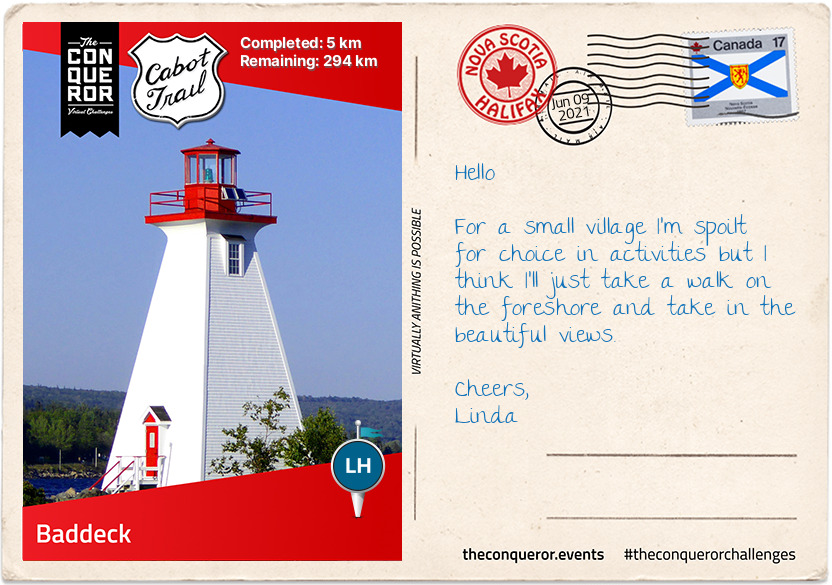
I got my first post card on the Cabot Trail!

I finally made it to Cape Breton Island, Canada. Having crossed Canso Causeway from Nova Scotia I made my way to the township of Baddeck. Here I'll commence my Cabot Trail journey, a 298km (185mi) loop around the northernmost part of the island.

The Cabot Trail was constructed in 1932 passing through and along Cape Breton Highlands. It was named after John Cabot who is thought to have landed here in 1497 but historians think he most likely landed in Newfoundland instead.

Baddeck is the start and end of the Cabot Trail. It is a bustling resort community established in the mid-1800s as French and British Settlements. Today it is awash with festivals and events celebrating Aviation Day, Celtic Music Festival, relay races, Regattas and Ceildihs (Scottish/Irish folk music, singing, dancing and storytelling). Baddeck is also a haven for golf enthusiasts, horseback riding and boat chartering.

Baddeck sits on the northern shores of Bras d'Or Lake which is connected to the Atlantic Ocean making this large body of water both fresh and salt water. The lake is 100km (62mi) long and 50km (31mi) wide with six rivers emptying into it. Popular with summertime boating, there's a long standing tradition of sailboat racing. Various yacht clubs host annual regattas and race weeks.

I'm told that Baddeck became a tourist destination after Charles Dudley Warner wrote a travel journal about his visit to the area in his 1874 publication of Baddeck, And That Sort of Thing. Although, I hear that many locals at the time weren't impressed with his description of the people as backward and simple. I may drop into the local library and have a scan of the book.


See ya,

Linda


This change . . . this change is going to be step by step - like all successful change, truth be told. 

 And so, I thought, though (especially during this Covid pandemic) I have not been particularly active - perhaps I could begin again. And I would start by walking, a little longer and a little further each day, until I could find myself again. 

"Where does it start? Muscles tense. One leg a pillar, holding the body upright between earth and sky. The other a pendulum, swinging from behind. Heel touches down. The whole weight of the body rolls forward onto the ball of the foot. The big toe pushes off, and the delicately balanced weight of the body shifts again. The legs reverse position. It starts with a step and then another step and then another that add up like taps on a drum to a rhythm, the rhythm of walking. The most obvious and the most obscure thing in the world, this walking that wanders so readily into religion, philosophy, landscape, urban policy, anatomy, allegory, and heartbreak."  ~ Rebecca Solnit

And so, I thought, though (because of the Covid pandemic) I have become loath to travel on planes and such anymore, I still wish to know of other places, other cultures, other ways of walking this world. 

The hat I wear when I venture out for a walk has a saying on it; it says "Not all who wander are lost". So why not travel virtually? And in a way that tracks my steps, my distance, my effort . . . my walks?

"A little here and a little there will always accumulate, so why be surprised when steady, small steps take you to great places?" ~ Richelle E. Goodrich

So I signed up for a Conqueror Challenge - a means of virtual walking/cycling/swimming, etc that ends in a pretty skucum medal and the wonderful sense of fulfillment after accumulating any number of kilometres or miles. Their motto is "make every mile count". Not only do you benefit health-wise by the incentive to exercise but at points that you achieve along your chosen challenge, they will plant a tree on your behalf! So the earth benefits too - not only from the hundreds of thousands of trees planted but by myself walking more and driving less. Win/win, I say!

I decided to start with the Cabot Trail, a trail that skirts around coast of Cape Breton Island. I chose it for a couple of reasons. We have moved to Nova Scotia and have not yet had the opportunity to explore the province more. I felt this was a chance to do so. It is 185 mi/298km long. I probably, on second thought, should have chose a shorter route for my first one but that is what I did. 

So, on June 4th, 2021, I signed up for the Cabot Trail. And got my race bib.


Cabot Trail Race Bib

 My fourth trail planted on the Cote D'Azure! Hi Linda,   You just passed the 80% milestone on the Côte d’Azur Virtual Challenge!  This ...